Imposter syndrome is that nagging feeling that you don’t really deserve your success, even when the proof is right in front of you. You got the job. You passed the exam. People keep telling you that you did well. Yet part of you still worries that someone will soon find out you are not as capable as they think. If that sounds familiar, you are far from alone. The Australian Bureau of Statistics National Study of Mental Health and Wellbeing (2020 to 2022) found that 21.4% of Australians aged 16 to 85, or about 1 in 5 people, had a mental disorder in the past 12 months. Anxiety disorders were the most common, affecting 17.2%. Imposter syndrome is not a mental disorder, but research links it closely with anxiety and self-doubt. These numbers show just how many Australians live with the kind of worry that can make you feel like a fraud.
If imposter syndrome is making you doubt yourself at work, study or home, contact me at Where’s Your Head At on 0499 993 077, visit 20/1 Maitland Place, Norwest NSW 2153, or book an appointment online. If you’d like, call or book a short phone chat first so I can answer any questions and help you feel prepared.
Key takeaways
- Imposter syndrome is the feeling that you are less capable than your results show.
- It is common, and it is not a mental health diagnosis.
- It often shows up after praise, a promotion, a new role or a mistake.
- Perfectionism, comparison and unfair workplaces can all make it stronger.
- Small steps, like keeping a “done” list and checking the evidence, can help you see your abilities more clearly.
- Counselling can help if self-doubt is affecting your work, mood or relationships.
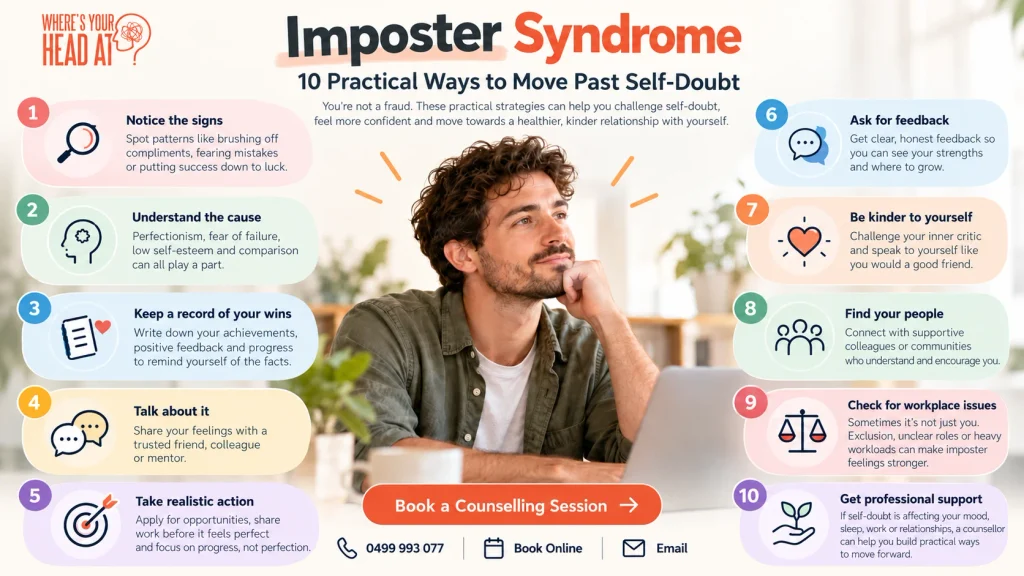
The 10 ways at a glance
- Spot the signs of imposter syndrome
- Find your imposter syndrome type
- Name the thought, not the truth
- Check the evidence
- Keep a “done” list
- Accept compliments
- Aim for “good enough”
- Compare yourself with your past self
- Separate self-doubt from workplace problems
- Get support when you need it
What is imposter syndrome?
Imposter syndrome is the ongoing feeling that you are not as smart, skilled or capable as other people think, even when you have clear proof that you are. You might put your success down to luck, good timing or simply working harder than everyone else. Psychologists Pauline Clance and Suzanne Imes first described this pattern in 1978 and called it the imposter phenomenon. You may also see it spelled impostor syndrome.
It is not a mental illness, and it is not listed in the DSM-5 or ICD-11. Still, it can affect your sleep, your confidence and how you show up at work, at uni or at home. Here are 10 ways to start taking its power away.
1. Spot the signs of imposter syndrome
You can’t change a pattern you can’t see. Imposter syndrome symptoms often show up as a gap between what you have done and how you feel about it. You might:
- Brush off compliments or feel uneasy when people praise you.
- Believe your success came from luck or extra effort, not skill.
- Worry that one mistake will show everyone you are a fraud.
- Over-prepare for tasks, or put them off because you fear getting them wrong.
- Avoid asking questions so you don’t look like you don’t know.
- Hold off on new roles until you feel 100% ready.
Many people get stuck in the imposter cycle. A new task brings on worry. You over-prepare or delay. It goes well and you feel brief relief. Then you credit luck or effort, and the doubt returns for the next task.
Try this: For one week, jot down each time you notice one of these signs and what set it off.
2. Find your imposter syndrome type
Dr Valerie Young describes five “competence types”. These types of imposter syndrome are not labels you have to fit. They simply help you spot the hidden rules you might be living by.
| Type | The hidden rule | What it can look like |
|---|---|---|
| The Perfectionist | My work must be flawless. | Focusing on one small flaw instead of everything that went well. |
| The Natural Genius | I should get it right straight away. | Feeling ashamed when a new skill takes time to learn. |
| The Soloist | I have to do it all on my own. | Seeing asking for help as a sign of weakness. |
| The Expert | I must know everything first. | Doing more courses before applying for a job you already qualify for. |
| The Superhero | I must excel in every role. | Saying yes to everything at work and home until you are exhausted. |
You can also reflect using an imposter syndrome test such as the Clance Impostor Phenomenon Scale (CIPS). It has 20 questions, with scores from 20 to 100. A score above 60 is commonly seen as frequent imposter feelings, and above 80 as intense. A quiz like this can help you reflect, but it cannot diagnose anything.
Try this: Pick the type that sounds most like you and write down its hidden rule. Then ask, “Would I expect this from a friend?”
3. Name the thought, not the truth
When doubt shows up, it can feel like a fact. Naming it helps you step back. Instead of “I’m not good enough”, say to yourself, “I’m having the thought that I’m not good enough.” This small change creates a bit of space between you and the thought.
Try this: Use the phrase “I’m having the thought that…” the next time you feel like a fraud.
4. Check the evidence
Imposter feelings often run on negative self-talk that ignores the facts. Write down the worry, such as “I made a mistake, so I can’t do this job.” Then list the evidence for and against it. A fairer version might be, “I made a mistake, and I can fix it with the skills I’ve already shown.” Speaking to yourself with self-compassion, the way you would speak to a good friend, can make this easier.
Try this: Draw two columns on a page, “evidence for” and “evidence against”, and fill both in honestly.
5. Keep a “done” list
When you feel like a fraud, your wins can be hard to remember. A “done” list keeps them in one place. Each week, note what you finished, what you learnt and any feedback you got. Include small wins too, like asking a good question in a meeting.
Try this: Set a 10-minute reminder every Friday to add to your list. Read it back when doubt hits.
6. Accept compliments
If you tend to say “it was nothing” or “I just got lucky”, you are training your brain to ignore your own ability. Next time someone praises your work, simply say “thank you”. You don’t have to fully believe it yet. Just let it land.
Try this: Write down one compliment you received this week and why the person might have meant it.
7. Aim for “good enough.”
Perfectionism and fear of failure keep imposter syndrome going. When good work never feels good enough, success stops counting. Set a clear finish line before you start a task, and share a draft before it feels perfect. Mistakes are part of learning, not proof that you don’t belong.
Try this: Before your next task, write down what “done” looks like. Stop when you reach it.
8. Compare yourself with your past self
Social media and workplace updates show other people’s wins, not their struggles. Comparing your behind-the-scenes to someone else’s highlight reel will almost always leave you feeling behind. If you already live with low self-esteem, these comparisons can hit even harder. A fairer measure is where you were six or twelve months ago.
Try this: List three things you can do now that you couldn’t do a year ago.
9. Separate self-doubt from workplace problems
Imposter syndrome at work often shows up around promotions, performance reviews, presenting in meetings or starting a new job. But it isn’t always “all in your head”. If you are often left out of meetings, passed over for training or judged by a tougher standard than others, that is a workplace problem, not faulty thinking.
Clance and Imes first studied imposter syndrome in women who were high achievers. Later research shows that people of all genders experience it. Being one of only a few people like you in a workplace can add extra pressure to prove you belong.
In Australia, employers have a legal duty to manage psychosocial hazards, such as very high job demands, poor support, unclear roles and bullying. You can learn more from Safe Work Australia’s guidance on psychosocial hazards. If work pressure is feeding your doubt, stress management counselling can help you sort out what you can control and what needs to change.
Try this: Keep a simple record of dates, meetings and decisions. It will help you see whether you need a mindset shift, a conversation with someone you trust, or both.
10. Get support when you need it
Saying “I keep worrying I don’t deserve this role” to a trusted friend or mentor can make the fear smaller. You’ll often find they have felt the same way. Sometimes, though, imposter syndrome sits alongside other struggles. A review of 62 studies by Bravata and colleagues (2020) found imposter feelings were commonly linked with symptoms of anxiety and depression, with reported rates ranging from 9% to 82%.
If constant worry is taking over, anxiety counselling can help. If you are feeling flat or hopeless, depression counselling is a good place to start. Many people with ADHD also describe feeling like a fraud, so ADHD counselling and neurodivergent-affirming therapy may help you understand how your brain works, without judgement. And if you feel exhausted most of the time, take burnout seriously.
Imposter syndrome counselling gives you a safe, confidential space to look at where your doubts come from. Therapy for imposter syndrome may draw on approaches such as Cognitive Behavioural Therapy (CBT), Compassionate Inquiry or Solution Focused Therapy. At Where’s Your Head At, Jonathan offers counselling and psychotherapy in Sydney, in person in Norwest and online across Australia. You may also find these services helpful:
- Couples counselling if self-doubt is affecting your relationship.
- Family therapy if family pressure or expectations play a part.
- Counselling for young people and youth mentoring for students and young adults building confidence.
- Christian counselling if you would like your faith to be part of the conversation.
- Professional supervision for counsellors and helping professionals who doubt their own practice.
You can check the session fees or get in touch with any questions.
Try this: Tell one trusted person about your self-doubt this week, or book a short chat with a counsellor.
Need help right now? Where’s Your Head At is not a crisis service. If you are in danger, call 000. For 24/7 support, call Lifeline on 13 11 14 or Beyond Blue on 1300 22 4636.
Final thoughts
Imposter syndrome can make you feel like you are always one mistake away from being found out. But doubt is not proof that you lack ability, and an unfair workplace is not a personal failing. Start with one way from this list, such as keeping a “done” list or naming the thought. Confidence often grows from doing, not the other way around. And if you’d like support along the way, you don’t have to work through it alone.
For support with imposter syndrome and self-doubt today, contact me at Where’s Your Head At on 0499 993 077, visit 20/1 Maitland Place, Norwest NSW 2153, or book an appointment online. If you’d like, call or book a short phone chat first so I can answer any questions and help you feel prepared.
FAQ
What is imposter syndrome?
Imposter syndrome is the feeling that you are less capable than other people think, even when you have clear proof of your skills. You might put your success down to luck or extra effort and worry about being “found out”. It is common and can affect anyone, in any job or stage of life.
What are the signs of imposter syndrome?
Common signs include brushing off compliments, crediting your success to luck, fearing that one mistake will expose you, and over-preparing or putting tasks off. You might also avoid asking questions or applying for new roles until you feel completely ready. These signs are patterns to notice, not a diagnosis.
What causes imposter syndrome?
There is rarely one cause. Perfectionism, fear of failure, low self-esteem and early messages about achievement can all play a part. Comparing yourself with others, starting a new role and being one of only a few people like you at work can also make the feeling stronger.
Is imposter syndrome a mental illness?
No. Imposter syndrome is not a diagnosis in the DSM-5 or ICD-11. It describes a common pattern of self-doubt where you feel less capable than your results show. It can still affect your mood, sleep, work and relationships, so it is worth taking seriously.
How do you overcome imposter syndrome at work?
Start by keeping a record of your wins and feedback, so you have real evidence when doubt shows up. Ask for clear feedback, share work before it feels perfect and talk with a trusted colleague or mentor. If exclusion or heavy workloads are part of the problem, raise them, as these are workplace issues.
Can imposter syndrome go away?
For many people it becomes quieter and easier to manage. The thoughts may still pop up when you start something new. With practice, you can notice them sooner, check the evidence and keep going instead of letting doubt make your choices.
Is imposter syndrome linked to anxiety or ADHD?
It can be. Research has found that imposter feelings often appear alongside symptoms of anxiety and depression. Many people with ADHD also describe feeling like a fraud, especially if they have worked hard to hide struggles with focus or organisation. If these overlap for you, counselling can help you untangle them.
When should you see a counsellor for imposter syndrome?
Consider talking to a counsellor if self-doubt is affecting your sleep, mood, work or relationships, or if it keeps coming back despite your efforts. You don’t need to wait until things feel serious. Counselling gives you a confidential space to understand your doubts and build practical ways to respond.
This article is general information only and is not a substitute for personal advice from a qualified health professional.